
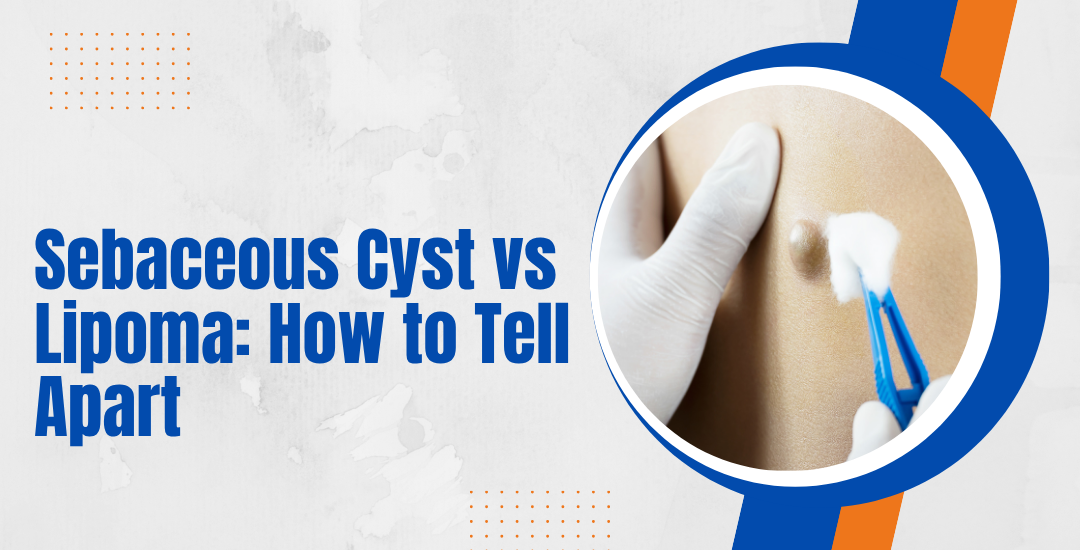
A sebaceous cyst sits just under the skin, feels firm, and often has a visible central punctum, while a lipoma sits deeper in the fat layer, feels soft and rubbery, and moves freely without any surface marking. Both are benign, but misidentifying them leads to the wrong removal technique and higher recurrence risk.
According to Dr. Shashank Agrawal, Sebaceous Cyst Treatment in Ghaziabad, “The clinical distinction matters because a sebaceous cyst requires complete sac removal to prevent recurrence, whereas a lipoma is shelled out from surrounding fat tissue two entirely different surgical approaches.”
What Are the Physical Differences Between a Sebaceous Cyst and a Lipoma?
These two lumps are often confused at home, but a careful physical check reveals clear differences in location, feel, and surface appearance. Four distinguishing features separate them clinically.
Feature | Sebaceous Cyst | Lipoma |
Surface Marking | Visible central punctum (small dark dot marking the blocked follicle or duct) | Completely normal overlying skin; no punctum, dimpling, or discolouration |
Consistency | Firmer and more tense, especially with accumulated keratin or long-standing presence | Soft and doughy; compresses like a small cushion of fat |
Depth & Mobility | Tethered to overlying skin; skin moves with the lump rather than independently | Lies in subcutaneous fat layer; slides freely in all directions when pressed |
Discharge History | May discharge thick, pale, foul-smelling keratin material | Never drains; contains fat cells, not a fluid-filled sac, with no skin surface connection |
Common Locations | Scalp, face, neck, and back | Upper back, shoulders, and arms |
Location matters too. Lipomas turn up commonly on the upper back, shoulders, and arms. Sebaceous cysts cluster on the scalp, face, neck, and back. Fistula treatment is another condition where precise identification before intervention determines whether the procedure succeeds or recurs.
When Does Each Lump Actually Need to Be Removed?
Neither condition is dangerous on its own, but both have clear situations where removal stops being optional and becomes the clinically sensible choice. Four triggers apply across both types.
- Infection: A sebaceous cyst that turns red, warm, and painful has become infected, and at that point it needs either incision and drainage acutely or planned excision once the inflammation settles, because a chronically infected cyst won’t resolve with antibiotics alone without the sac being physically removed.
- Rapid growth: Any lump, whether cyst or lipoma, that doubles in size over a few months needs evaluation to rule out something more serious before assuming it’s still benign, because both sebaceous cysts and lipomas can occasionally mask a deeper lesion that imaging won’t fully clarify without histology.
- Pressure symptoms: A lipoma sitting over a nerve, joint, or bony prominence causes pain and restricted movement that won’t improve without removal, since fat tissue doesn’t shrink on its own and the mechanical pressure on surrounding structures only worsens as the lump enlarges.
- Cosmetic and functional concern: Lumps on the scalp, face, or neck that affect confidence or interfere with daily tasks like wearing a collar or using a helmet are entirely reasonable indications for planned surgical removal, and both procedures are short, typically done under local anaesthetic.
And recurrence after incomplete removal is the most avoidable surgical complication there is. Getting the whole sac out the first time is what prevents it. Laser surgery for piles success rate reflects the same principle that technique and completeness of removal directly determine long-term outcomes.
A lump that’s growing slowly or started draining a cheesy discharge?
Why Choose Dr. Shashank Agrawal?
Dr. Shashank Agrawal holds an MBBS, MS in General Surgery, and DNB in Surgical Gastroenterology, with dual Fellowships in Advanced Hernia Surgery and Advanced Colorectal Surgery (FALS). With over 10 years of surgical experience, he has performed a high volume of soft tissue excisions including sebaceous cysts and lipomas using techniques that minimise scarring and eliminate recurrence.
Patients don’t leave with a lump that grows back six months later. Clean excision, proper closure, and clear post-op guidance that’s what the visit looks like.
Frequently Asked Questions
Can a sebaceous cyst go away without treatment
Small uninfected cysts may remain stable for years but don’t resolve on their own.
Is it safe to squeeze or pop a sebaceous cyst at home?
No squeezing ruptures the sac internally and significantly increases infection and recurrence risk.
Can a lipoma turn into cancer?
True lipomas are benign and don’t become cancerous; rapidly growing lumps need assessment to rule out other diagnoses.
How is a sebaceous cyst removed without it coming back?
Complete excision of the intact cyst wall is what prevents recurrence partial removal almost always leads to regrowth.
