
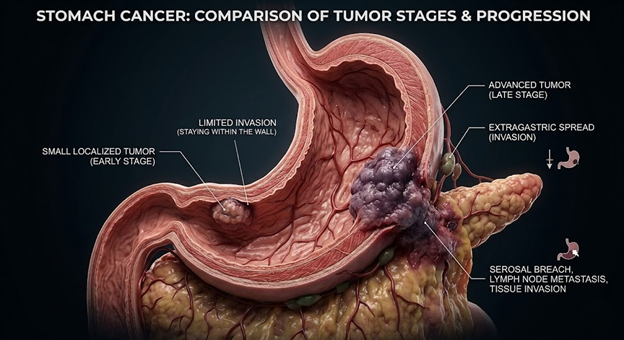
Stomach tumor survival rate depends on two things above everything else: the type of tumor and the stage at which it is found. For gastric adenocarcinoma, the 5-year survival rate is 75% when the disease is still confined to the stomach. That number falls to 7% once it has spread to distant organs. For gastrointestinal stromal tumors, the overall 5-year survival sits at around 85%.
Most patients in India come to a specialist only after months of living with symptoms. By the time they walk in, the disease has often already progressed well beyond the stomach. That delay alone accounts for a significant portion of poor outcomes seen in gastric cancer.
Dr. Shashank Agrawal, Gastroenterologist in Ghaziabad, says:
“Stomach tumors are one of those conditions where timing changes everything. When patients come in after months of ignoring symptoms, I often find the disease has already moved beyond the stomach. I tell every patient the same thing: the survival rate is significantly better when we catch it early, surgery gives us a real chance at a cure in localized cases, and outcomes are far more favorable when the right treatment is started without delay.”
Types of Stomach Tumors and Why the Type Changes Everything
A stomach tumor is not a single disease. The stomach can develop several distinct types of tumors, and each one behaves differently, responds to different treatments, and carries a different prognosis.
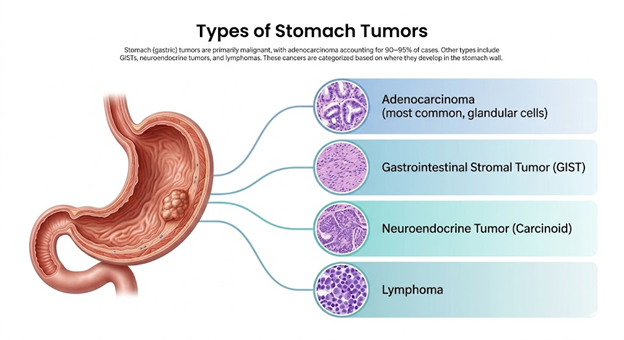
Here are the four main types:
- Gastric Adenocarcinoma – This is what most people mean when they say stomach cancer. It starts in the cells lining the inner surface of the stomach and accounts for 90-95% of all stomach cancers. It tends to be aggressive, and survival is closely tied to how early it is caught.
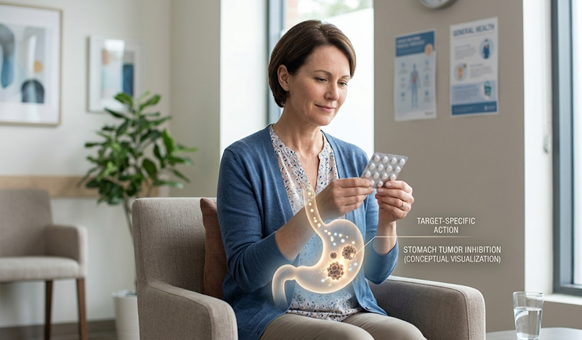
- Gastrointestinal Stromal Tumor – GIST develops in the connective tissue of the stomach wall rather than the lining. It is a very different disease from adenocarcinoma and responds well to targeted oral medication. Survival rates are considerably better across all stages.
- Gastric Lymphoma – Lymphoma of the stomach accounts for about 4% of stomach tumor cases. Because it responds well to chemotherapy and radiation, outcomes tend to be more favorable than adenocarcinoma when diagnosed at a treatable stage.
- Carcinoid and Neuroendocrine Tumors – These account for around 3% of stomach tumor diagnoses. They grow slowly in most cases and outcomes are generally good when caught early.
Knowing the exact tumor type is not just clinically important. It determines whether the patient needs surgery, targeted therapy, chemotherapy or a combination of all three. As a Gastroenterologist in Ghaziabad, Dr. Shashank Agrawal assesses tumor type, grade and stage before any treatment decision is made.
Stomach Cancer Survival Rate by Stage
| Stage | Where the Cancer Has Spread | 5 Year Survival Rate |
| Localised | Confined to the stomach | 75% |
| Regiona | Spread to nearby lymph nodes or organs | 35% |
| Metastatic | Spread to distant organs like the liver | 7% |
| Overall | Across all stages | Around 38% |
Roughly 37.9% of stomach cancer patients survive beyond 5 years when all stages are included. More than half of cases could potentially be cured if caught before the cancer leaves the stomach wall. The problem is that only 10 to 20% of cases are diagnosed at that early point. Most patients present with regionally advanced or metastatic disease and that is what keeps overall survival numbers where they are.
GIST Survival Rate in the Stomach
GIST is a different story from adenocarcinoma and a more hopeful one for most patients. The availability of imatinib, a targeted oral medication, has changed outcomes in this disease significantly over the last two decades.
What the survival numbers look like for GIST:
- Overall, 5 year survival rate sits at 85%
- When the disease is localised it reaches 77%
- For regional disease the figure is 64%
- In metastatic disease survival is 41%
GISTs found in the stomach tend to do better than those found in the small intestine or rectum even when tumor size and behavior appear similar. Imatinib has improved 2 year survival in advanced GIST to somewhere between 75 and 80% which represents a dramatic shift from where outcomes stood before targeted therapy was available.
For a full assessment of your condition explore stomach cancer treatment in Ghaziabad to understand which treatment pathway is appropriate for your specific tumor type.
What Actually Affects Survival in Stomach Tumors
Several clinical factors shape outcomes beyond just stage and tumor type:
Stage at diagnosis
Nothing predicts survival more reliably than stage. Tumors confined to the stomach are resectable and potentially curable. The further the disease has spread by the time it is found the fewer curative options remain available.
Tumor type and biopsy findings
Adenocarcinoma and GIST require completely different treatment approaches. A biopsy with histopathological analysis is non negotiable before treatment starts. Treating without knowing the exact tumor type leads to poor outcomes.
Tumor size and location
Tumors larger than 5 cm and those dividing rapidly carry a worse prognosis. Gastric GISTs generally behave less aggressively than GISTs found in the small intestine or rectum of comparable size.
Whether surgery can completely remove the tumor
Complete removal with clear margins significantly improves survival in both adenocarcinoma and GIST. If the tumor is not fully removed or ruptures during surgery the risk of recurrence in the abdominal cavity increases substantially.
The patient’s age and general health
Older patients and those with significant comorbidities like heart disease, diabetes or malnutrition face higher surgical risks and generally have a less favourable prognosis. Overall fitness directly affects what treatment options are feasible.
Molecular subtype in GIST
KIT exon 11 mutations respond well to imatinib. PDGFRA D842V mutations are resistant to imatinib and need a different targeted agent called avapritinib. Getting the molecular profile right matters enormously in GIST management.
Traditional surgery still has its place in complex or advanced Grade 4 cases. But for the large majority of patients, laser surgery is the better choice — less painful, faster, and equally effective in the long run.
Symptoms That Should Never Be Ignored
Stomach tumors rarely announce themselves dramatically in the early stages. Most patients describe a slow build of symptoms they initially put down to acidity, stress or a busy lifestyle. By the time the symptoms become impossible to ignore the disease has often already progressed.
Seek evaluation if you notice any of the following:
- Persistent pain or discomfort in the upper abdomen lasting beyond two weeks
- Feeling full very quickly after eating even small amounts of food
- Unexplained weight loss with no obvious dietary cause
- Blood in vomit or stools that appear black and tarry
- Nausea or bloating that does not settle with routine medication
- Difficulty swallowing that is getting progressively worse
Certain groups carry a higher risk and should be screened proactively:
- People with a confirmed Helicobacter pylori infection
- Those with a family history of gastric cancer
- Patients with chronic atrophic gastritis or intestinal metaplasia
- Smokers and heavy alcohol users
- Anyone above 50 years of age with persistent upper GI symptoms that keep returning
Treatment Options That Improve Stomach Tumor Survival
Surgery and Gastrectomy
For localised stomach tumors surgery is the only treatment that offers a genuine chance of cure. Partial or total gastrectomy with lymph node dissection remains the gold standard. Many patients are concerned about recovery time and it is worth knowing that advanced laparoscopic surgery offers significantly shorter recovery compared to conventional open gastrectomy while achieving the same surgical outcomes.
Targeted Therapy for GIST
Imatinib remains the first line treatment for advanced and metastatic GIST and works well in 60 to 70% of patients. When resistance develops sunitinib or regorafenib are the next options. Research has shown that three years of adjuvant imatinib after surgery produces better recurrence free survival than stopping treatment at one year.
Chemotherapy and Immunotherapy for Gastric Adenocarcinoma
Advanced gastric adenocarcinoma is treated with chemotherapy. HER2 positive tumors benefit from trastuzumab alongside chemotherapy. Tumors that express PD L1 have shown meaningful responses to pembrolizumab in recent trials making immunotherapy an increasingly important part of advanced gastric cancer management.
Multimodal Treatment
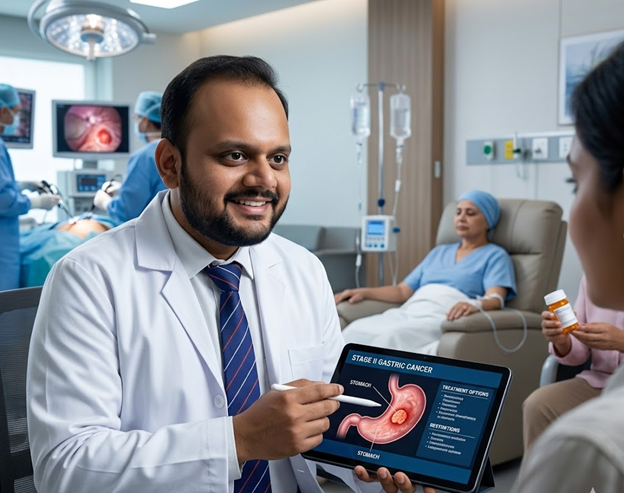
Giving chemotherapy before surgery to shrink the tumor or after surgery to reduce recurrence risk has become standard practice for stage 2 and stage 3 gastric cancer. The combination of surgery with systemic therapy consistently produces better outcomes than surgery alone in locally advanced disease.
Conclusion
Stomach tumor survival depends on catching the right tumor at the right stage and treating it with the right approach. For early gastric adenocarcinoma a 75% five year survival is achievable. For GIST overall survival reaches 85%. For advanced metastatic gastric cancer the picture is far more difficult and that reality underscores why acting on symptoms early matters so much.
Patients who come in early leave with treatment plans aimed at cure. Patients who wait leave with plans aimed at control. That difference is what drives every survival statistic in this disease.
Frequently Asked Questions
What is the survival rate for a tumor in the stomach?
Is a stomach tumor always cancerous?
What symptoms suggest a stomach tumor?
Can a stomach tumor be completely cured?
How is GIST different from gastric adenocarcinoma?
When is the right time to see a GI surgeon?
